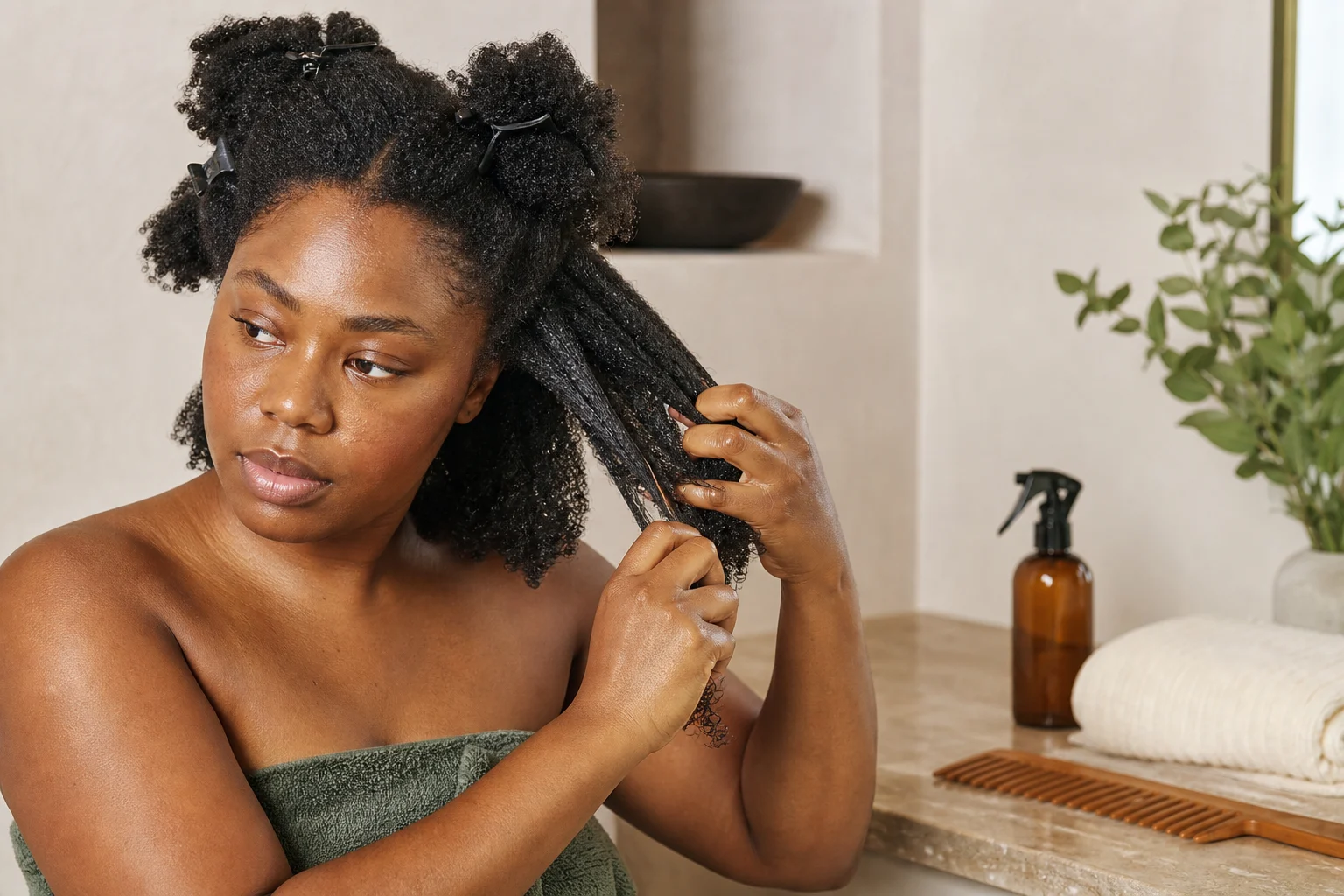
Detangling 4C Hair Without Losing Half of It
The order of operations for detangling coily hair, single-strand knots, and how to tell shedding …
Read →
Transitioning means growing out relaxed hair and cutting it off over time, rather than all at once. It’s slower than the big chop and it lets you keep length — but it puts you in the hardest situation in hair care: two completely different textures on the same strand.
Whichever route you pick, the thing that decides how it goes is how you treat the line where the textures meet.
The big chop — cut off all relaxed hair at once, start with a TWA (teeny weeny afro).
The long transition — grow it out, trim gradually over 6–18 months.
Neither is more legitimate. Anyone telling you a big chop is the “real” way to go natural is describing their preference, not a rule.
Where new growth meets relaxed hair, the strand changes structure abruptly. That junction is the weakest point on your entire head, and it’s where transitioning hair snaps.
What protects it:
The practical problem: your roots are coily and your ends are straight. Styles that force one look onto both will break the line.
What works:
What doesn’t:
Worth knowing, since it’s often left out of the conversation.
A 2022 analysis from the NIH Sister Study, published in the Journal of the National Cancer Institute, found that women who used chemical hair straighteners frequently — roughly more than four times a year — had a higher incidence of uterine cancer than women who didn’t use them. The Silent Spring Institute has separately found that hair products marketed to Black women are more likely to contain endocrine-disrupting chemicals.
Two honest caveats: these are association studies, not proof of cause, and the absolute risk for any individual remains low. This isn’t a reason to panic about relaxers you used in the past.
It is a reason to know what’s in the bottle. You can paste any product’s ingredient list into our ingredient checker — sodium hydroxide and guanidine carbonate are the relaxer actives, and both are flagged there with the source.
Plenty of people transition for reasons that have nothing to do with health — cost, time, curiosity, or just wanting to see their own texture. All of those are complete reasons on their own.
| Months | What’s happening | What to do |
|---|---|---|
| 0–3 | 1–2" new growth, line not yet obvious | Establish moisture routine, start trimming |
| 3–6 | Line becoming obvious, breakage risk rises | Blending styles, low manipulation |
| 6–12 | Real texture visible, relaxed ends thinning | Trim more aggressively, protective styles |
| 12–18 | Mostly natural | Final trims, learn your actual texture |
Hair grows roughly half an inch a month. If your relaxed length is six inches and you refuse to cut, you’re looking at a year or more. Trimming shortens that considerably.
The one rule: protect the line where the textures meet. Moisture, minimal manipulation, regular trims, no heat. Everything else is style preference.
See the American Academy of Dermatology’s Black hair care guidance for dermatologist-reviewed baseline practices.
The order of operations for detangling coily hair, single-strand knots, and how to tell shedding …
Read →
Why your scalp itches in braids, how to tell dandruff from dryness and buildup, and when itching is …
Read →
Bonnets, satin, pineappling, and re-twisting — how to protect natural hair overnight so a style …
Read →The wash day routine, the ingredients to skip, and where to spend versus save. Unsubscribe in one click.