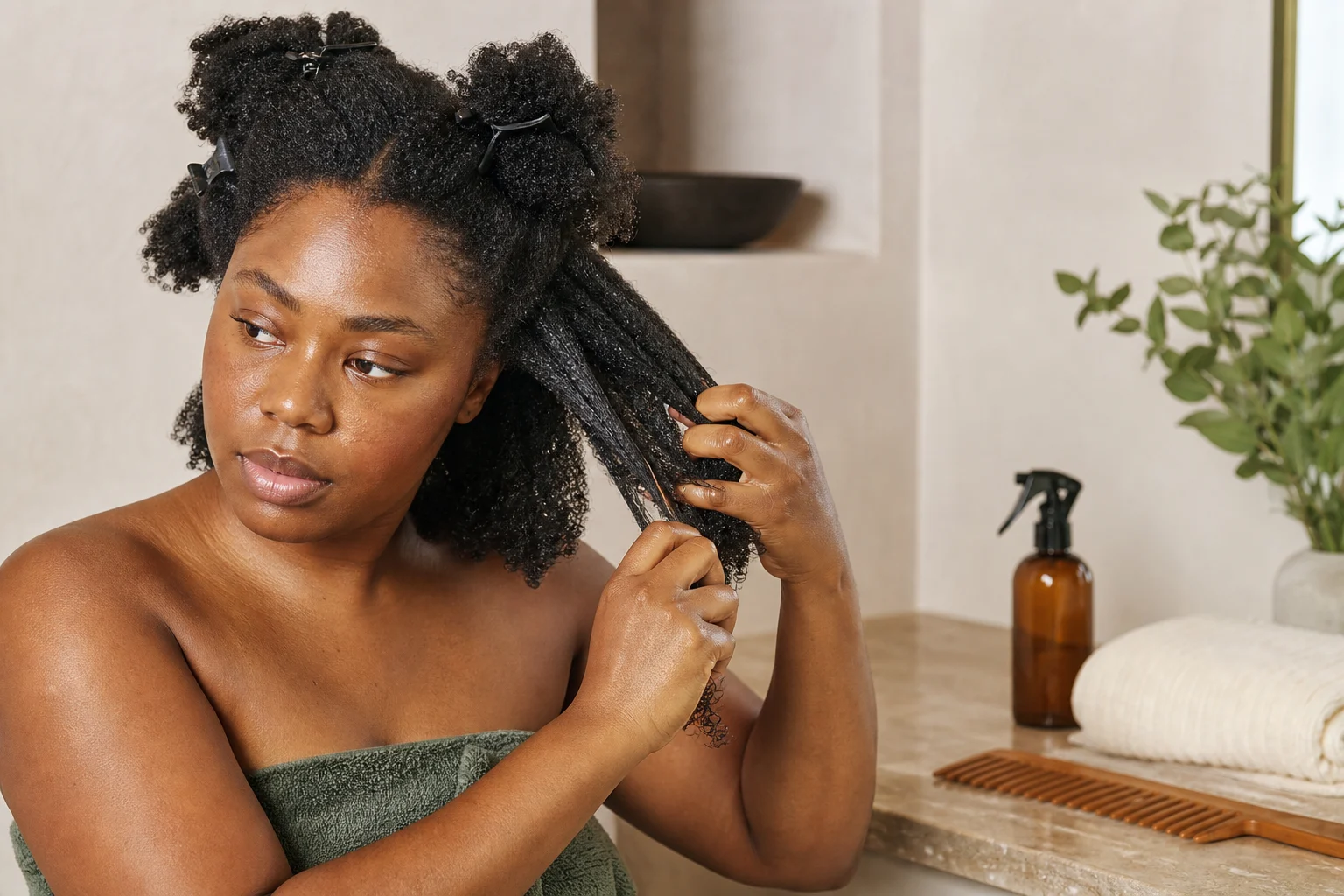
Detangling 4C Hair Without Losing Half of It
The order of operations for detangling coily hair, single-strand knots, and how to tell shedding …
Read →
You spend three hours on wash day and then sleep on it for eight. Whatever happens in those eight hours decides whether the style lasts one day or six.
The bonnet is not a stereotype to be embarrassed about — it’s the most efficient piece of hair care equipment ever invented. Five minutes at night saves an hour in the morning.
Cotton is absorbent and rough. That combination does two things to textured hair every night:
Satin and silk are smooth and non-absorbent. Hair slides instead of snagging, and the moisture stays where you put it.
Satin vs silk: silk is a natural fibre and breathes better. Satin is a weave, usually polyester, and costs a fraction as much. For hair purposes the practical difference is small — buy satin and spend the savings on something else. What matters is that it isn’t cotton.
Simplest and most effective. Everything goes in, band sits at the hairline, done.
Look for an adjustable band — the elastic in cheap bonnets either strangles your edges or gives up by 3am. And size up if you have volume; a bonnet that compresses a twist-out flattens it.
Best if you’re a bonnet-loses-it-at-night person, or you share a bed and would rather not. Less protective than a bonnet since your hair still moves against the case, but far better than cotton and it requires zero discipline.
Ideal setup is both.
More control than a bonnet, better for laying edges or holding a specific set. Takes practice and can be too tight — apply the same tension rule as everything else: if it hurts, it’s wrong.
Covering is only half of it. What you do underneath decides how the style looks tomorrow.
Re-twist in 4–8 large sections. Not the 20 small twists you originally set — big, loose ones, purely to preserve the pattern. Two to three minutes. This is the single highest-return habit in natural hair care.
Add a small amount of leave-in only if your hair feels dry. Every night with product is how buildup starts.
Pineapple it. Flip your head forward, gather everything loosely at the very top with a satin scrunchie, and bonnet over it. The point is that your curls sit above your head instead of being crushed under it.
Never use a regular elastic. A satin scrunchie or a loose length of fabric only.
Bonnet or scarf, no prep needed. The install is the protection. Mostly you’re preventing frizz on the braids themselves and stopping the cotton from drying out your scalp.
Two loose braids or a low, loose bun with a fabric tie. Sleeping on genuinely loose textured hair is how you wake up to a tangled mat.
Going to bed with wet hair. It won’t dry properly under a bonnet, you’ll wake up to a flattened, frizzy set, and consistently damp hair against your scalp is an invitation for fungal issues. Dry first.
Elastic hair ties. They snap hair every single time. Satin scrunchies or fabric.
Re-applying product every night. Buildup, weighed-down roots, and a routine that mysteriously stops working after a few weeks.
The bonnet that’s too tight. Tension at the hairline for eight hours a night is the same mechanism as a too-tight braid install — see protective styles and edge loss.
Not washing the bonnet. Product, oil, and scalp residue build up in it. Wash weekly.
| Night | Twist-out | Wash-and-go | Braids |
|---|---|---|---|
| 1 | Re-twist 6–8 loose | Pineapple | Bonnet |
| 2 | Re-twist 4–6 | Pineapple | Bonnet |
| 3 | Light mist, re-twist | Pineapple | Bonnet |
| 4 | Re-twist frizzy sections | Refresh, pineapple | Bonnet |
| 5–6 | Re-twist, or bun it | Bun or refresh | Bonnet |
| 7 | Wash day | Wash day | Bonnet |
Three habits carry almost all of the benefit:
That’s it. Everything else is refinement, and none of it takes more than five minutes.
Related: how to do a twist-out that holds and the full wash day routine.
See the American Academy of Dermatology’s Black hair care guidance for dermatologist-reviewed baseline practices.
The order of operations for detangling coily hair, single-strand knots, and how to tell shedding …
Read →
Why your scalp itches in braids, how to tell dandruff from dryness and buildup, and when itching is …
Read →
Big chop or long transition, how to handle two textures at once, and what the research actually says …
Read →The wash day routine, the ingredients to skip, and where to spend versus save. Unsubscribe in one click.